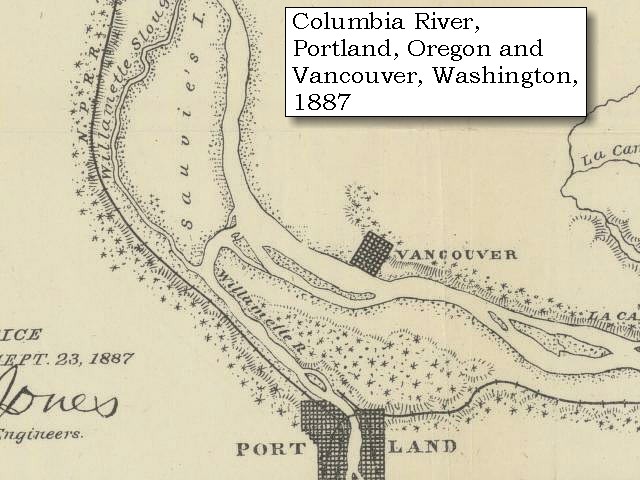
Republicans are convinced they need to work on messaging, not policy, in order to win national elections. A look at the sister cities of Portland and Vancouver illustrate why they may be wrong.
____________________________________
Last week at Politco’s State Solutions Conference, Republican Tennessee Governor Bill Haslam offered up an explanation for the GOP’s defeat at the ballot box this past November: poor messaging. According to Haslam, Republicans simply weren’t able to effectively communicate to voters that conservatives stood for lower taxes for everyone, especially for businesses that might look to invest that money.
“I don’t think we did a very good job explaining ourselves,” said Haslam.
Haslam is not alone. “Messaging” is being asked to do a lot of heavy lifting for Republicans these days, especially those struggling to explain both their inability to take the White House and why their national support continues to dwindle. Over the past month GOP celebrity-leaders such as Eric Cantor, Marc Rubio, Rand Paul and Frank Lutz, among others, have insisted that the GOP doesn’t need new ideas; it simply needs to do a better job of communicating its old ones to voters. The message that government is the problem and that the lives of citizens would be better if they paid less in taxes is a winner, they claim. The people are longing for these changes; they simply cannot decipher which party might be making such an offer. Change the rhetoric so that it is clearer, swap out negative words with peppy ones, and the ballot chads will practically punch themselves. At least, this is what Republicans seem to be telling themselves. I must confess that I find the notion that the public is stymied over which of the two major political parties runs on Lower/No Taxes and Government is Bad rhetoric to be highly dubious. But for the sake of argument, let us assume that this question is undecided and needs to be tested.
Today’s leading conservatives, be they pundits, media figures, think-tank celebs or actual politicians, seem sold that there are only two possible stories when it comes to government expenditures. The first is that no one wants the government to spend on non-military programs and yet the “government class” does so regardless; the second story is that only those who get things for “free” from the government support such expenditures. The possibility that one or both of these stories is wrong is so foreign an idea as to not be seriously considered at all. What if there is a third and more obvious choice? What if most voters are well aware that certain programs cost them money, and actively choose to pay for them anyway? Is it possible that even though no one likes paying taxes to the government (in the same way no one “likes” paying their cell phone bill to their provider) that most people still prefer to actually pay for the “boondoggles” and pork-laden communities government today so often provides – even those who don’t get these things for “free?” In other words, are the Republicans merely in need of better messaging for their old ideas; or do they need to find new ideas to message?
In order to best answer this question we’d first need to find a way to test the GOP’s messaging hypothesis. After all, we obviously can’t go back in time and rewrite GOP talking points to see if they’d change the 2012 election results.
But what if we could find a large enough sample group of American taxpayers who for decades have been given the choice to live in one of two cities – one highly taxed and regulated, the other pitching itself as a low tax, minimum-regulation, Going-Galt alternative? Could we use such a setup as a microcosm, a laboratory to see which choice people made with their actual lives regardless of talking points? If so, we’d want to make sure that these cities were close enough to one another that the barriers of moving your home or business would be minimized. You would want them to be close enough that, were taxpayers to move their home from one city to the other, they could continue to work for their current employer; likewise, if a business moved, its employees could choose to retain their positions without having to move their homes. If you could find two such cities, would they support or dispute the claims imbedded in GOP messaging – and might they give some clues as to different conservative missions the GOP might try messaging to win voters’ hearts and confidence?
It just so happens that these two cities actually exist – and I live in the heart (or shadow) of each of them.
____________________________________
In the late 1990s during the advent of real conservative talk radio in the Pacific Northwest, one of the staple talking points was the imminent death of Portland, Oregon. The story talk radio hosts pitched – and that GOP candidates would nod along with – was that Portland’s government was out of control, throwing money away on special interest pet projects that no one really wanted. It might be one year, or two, or maybe even five, but one thing was certain – the City of Roses was about to be turned into a ghost town. The exodus would begin soon, we were assured, as city council members’ crazed schemes to turn our metropolis into a monument to the Government Class forced taxpayers’ hands and led them to a shiny new city on the hill – or to be more precise, a city just across the river: Vancouver, Washington.
 For movement-conservative pundits living in Portland, Vancouver was (and still is) the city Portland should strive to be. The population is about a third of its big-sister city, but it is growing. City planning is largely left to the private marketplace rather than government officials. Developers who wish to build commercial or residential buildings are largely able to do so on their own terms. Vancouver lacks the physical density requirements Portland’s government mandates, so you can build a McMansion or Wal-Mart of just about any size pretty much wherever you can purchase land – and because building codes are far more lax than in Portland, you can do it for considerably less.[1]
The big difference between the two, however, is the different attitude toward each city has toward taxes.
Both cities have taxes, of course, but where Portland politicians continue to ask taxpayers to fund “urban investments” Vancouver largely operates on the theory that citizens should be allowed to keep as much of their hard-earned dollars as possible. In each election cycle, Portland asks its citizens to approve bonds for libraries, parks, public transportation, and all matters of (sometimes very expensive) upkeep, rebuilding or brand new projects. There might have been a time in the past decade where Portland voters declined such a bond, but if so I’m not remembering it. Vancouver on the other hand asks little of its citizenry in these areas, and when they do the battles are far testier. Conservative pundits say that Portland is a far more expensive city to live in; what’s more, when compared to Vancouver it is clearly a city that spends huge amounts of money on things that are simply unnecessary. They are, of course, 100% correct on both of these counts.
 Vancouver spends some money on parks and green spaces, but not nearly as much as Portland. There are exceptions of course (cool, awesome exceptions), but most of Vancouver’s city parks are small and made for inexpensive upkeep: a pre-constructed play area on bark dust with a patch of grass separated by swaths of concrete is the norm. This type of planning creates far less of a financial burden than Portland asks of its taxpayers, which is constantly looking to create or maintain more than 400 public parks and greenspaces. (This include a zoo, an arboretum, a French Renaissance-style mansion, water fountains, a big-ass oak tree, parks dedicated to roses, rhododendrons, Japanese gardens, attracting butterflies, tricycle racetracks, runners/walkers/cyclists, not to mention a 5,100 acre urban forest with over 70 miles of public trails and a park that measures 452 square inches.) This difference between Vancouver’s and Portland’s vision of parks and greenspaces comes with a price tag, obviously. Vancouver’s parks budget is $9 million. Portland has just over three times the population, but its park budget is around $161 million. It’s so big, in fact, that some of the larger parks go out into the community and request additional donations in addition to their sizable allotted tax revenue.
 And when it comes to high-volume tax-dollar spending, it isn’t just the parks system that separates the sister-cities. Multnomah County Library, the library system that services Portland, isn’t just more expensive that Vancouver’s system – it’s more expensive than just about any system in the country, spending twice as much per resident than the national average. Portland’s mass transit system (which shares funding and services with two additional Oregon counties) has buses that run three times more frequently than Vancouver. What’s more, they have a very expensive light rail system, a phenomenally expensive aerial tram, and a near-free (for riders) streetcar that travels throughout the different downtown-area shopping districts. Portland clogs its calendar with literally hundreds of “free” events for citizens and visitors alike, including the Rose Festival, Chamber Music Northwest, Portland Blues Festival, The Bite, Cinco De Mayo, Portland International Beer Festival, Bridge Pedal and the holiday Festival of Lights. It even subsidizes the Rose Garden Arena, home of the NBA franchise Portland Trail Blazers owned by the absurdly wealthy Paul Allen.
If ever there were a city that “spends its taxpayers’ money like a drunken sailor” (to borrow an oft-used conservative talk-radio phrase), it is Portland, Oregon. In comparison, Vancouver is a cranky, tightwad spinster who acts as a model of fiscal restraint – and its citizens reap the comparative tax-benefit rewards. When faced with choosing between the two cities, Vancouver residents can boast of a cheaper tax rate, more square footage per housing dollar, and (comparatively, anyway) a hands-off government that gives its people the freedom do or build whatever the hell they want wherever the hell they want. Vancouver is, in other words, the very symbol of the lifestyle conservatives say the people long for, located just a dual-truss bridge away from a city that clearly represents everything conservatives assure us that the people despise.
So why do so many more people continue choose Portland?

The bottom line is that, by any conceivable measuring stick, Portland attracts and retains more taxpaying residents and businesses than Vancouver. This despite the fact that Vancouver taxpayers really do get houses for cheaper, pay fewer dollars in taxes and have less government intrusion.
Conservative soothsayers have been correct in their predictions of Vancouver growth, if somewhat off on scale. In 1999, its population stood at just under 119,000. In the thirteen years that followed Vancouver added 46,000 citizens as it swelled to 165,000. However, those same soothsayers have been and continue to be entirely wrong about Portland’s prospects. Portland has continued to grow as well, adding nearly twice as many new citizens as its cross-river sister during the same time period. So even though Vancouver is growing, it continues to fall further and further behind Portland.
 In fact, Portland does more than simply continue to grow. It continually beats Vancouver in the battle for the hearts of those most coveted of taxpayers: those from the higher income brackets. Vancouver’s median household income (MHI) is around $45,000, twenty percent below Washington state average. Portland’s, on the other hand, is currently over $50,000. And that discrepancy is growing: since 2000 Vancouver’s MHI increase has been less than 10%, while Portland’s has grown by 20%. Local conservative pundits have long been insisting that Portland’s highest earners would Go Galt to Vancouver, but in fact the opposite has transpired. Vancouver is becoming the city people move to when they can no longer afford to live in the City of Roses or its suburbs. And when their financial situation improves, they often move back.
The same holds true on the business side of things. Vancouver has plenty of successful businesses, but they are still dwarfed in number and scale by those in Portland. Since business is all about the bottom line, I wondered about this and called a friend of mine who is a very conservative Republican and the managing partner of a top-20 Portland investment firm. If it cost so much less to run his business in Vancouver, why didn’t the firm up and move? After all, most of what they did was done electronically; they could surely operate just as easily out of Vancouver as from their expensive digs in downtown Portland.
“Well, we might keep more of every dollar,” he conceded, “but I think we’d see a whole lot less dollars coming in the door. I’m pretty sure our top earners want to work in Portland. They’d probably all jump ship. And come on, if you got a call from a salesman asking you to put all your money with some guy in a strip-mall in Vancouver, you’re hanging up on him – right?”
 Though perhaps a bit snobby, the “strip mall” snark is not entirely unfair. Vancouver business buildings are generally built on the cheap and the city lacks the regulatory standards that encourage building for density, so there are no real high-rises. The city is very, very flat; almost all white-collar business is done out of a strip mall or a non-descript, single-story business park. And my friend’s response really does drill down to the heart of it. Despite the conservative talking points that I’ve heard him actually make, given the choice, my Republican friend and more than half a million others choose to live and work in Portland – not despite government spending, but because of it.
Portland’s building and zoning codes might be overly ham-fisted, but the neighborhoods, business areas and shopping districts are beautiful and vibrant. (Ironically, between the two sister cities it is the one that minimizes taxes, zoning and regulation that looks most like the grey, soulless Eastern-European Soviet-bloc cities of the 1970s.) Their mass transit system may not be the cheapest, but Portland traffic is far better than most metropolitan areas I have encountered. In fact, the hardest place in the greater Portland-Metro area to get to by car is Vancouver; its lack of planning and zoning make driving a confusing and bottlenecked mess even when it isn’t rush hour. What’s more, well-off Republicans might well want Wal-Mart to have the freedom to build in any neighborhood, but once it’s built most have no desire to continue living in a neighborhood that has the excess traffic issues Wal-Mart and other Big Box stores bring with them. Ambitious and costly library systems, parks, green spaces, neighborhood renovations, festivals, mass transit options and city planning don’t drive people from Portland. They attract people to it. To believe otherwise is to ignore the data.
And yet despite all of this, the truth is that Portland is far from a perfect city. Republicans would be wise to take note of the areas where it fails and build missions to address those failings.
For example, the Portland Public School system is atrocious. Class sizes are ridiculously large and extra-curricular activity options are few. Most of the issues are budget-based. Bloated administrative costs, a teacher’s union that fights for more money but not necessarily more teacher-hires, a string of failed but expensive high-profile executive hires and a lack of clear, sustained vision makes the district enormously inefficient – so much so that I’m not convinced that more revenue will fix problems so much as exacerbate them. My son is a junior in high school. In addition to Portland having one of the worst days-in-school/days-in-the-calendar ratios in the country, every other day he has classes from 9:30 – 12:55, and that includes a lunch period. His sophomore English class consisted of a curriculum with no homework, where the kids would listen to the teacher read books to them for their class period. Thank goodness he goes to one of the schools in the higher-income neighborhoods – my understanding is that schools in the lower-income neighborhoods are significantly worse. Because of this situation, Portland loses a lot of families to its own suburbs.
 What’s more, since the delights of Portland come with a steep price tag, it means that as those median incomes rise it becomes harder and harder for lower-income people to stay. Our poorer neighborhoods are continually revitalized with amazing, creative gentrification projects that really do work. Two decades ago the area just north of Burnside Street was Portland’ equivalent to skid row. Revamped and renamed the Pearl District, it’s currently our city’s hippest place to live, featuring world-class restaurants and seven figure condos. Which is great for people who can afford seven figure condos, but a bit of a problem for those who are displaced by these gentrifications.
I suspect that all of these dynamics are not unique to Portland. And as such, I suspect that they present opportunities for Republicans looking to again be nationally relevant. By an overwhelming majority, people don’t want to live in Vancouver. They want to live in Portland. As it turns out, this is especially true of those potential Galts who are flipping the bill. So why not focus on a way to make living in Portland better, more effective and more efficient?
For example, Portland conservative pundits follow the national trend with education. Less taxes and less government will magically fix the problem, we are told – which is really all we’re told about every problem. But what if Republicans chose instead to be a champion for public schools, looking not to defund them but to run them better and more efficiently? What if instead of simply saying that government can’t work, they sought a way for it to work better and cheaper? It would require work and an investment in both time and capital. Saying Taxes + Government = Bad!/Freedom = Good! over and over is pretty cheap and takes little in the way of specifics; coming up with a plan to make the system better would be comparatively hard and expensive. It would, however, give the public an alternative it might actually want.
Republicans might also do well to embrace the poor rather than demonize them. It blows my mind that the Portland liberals in power create systems that drive lower-income people and a disproportionate number of minorities out of the city, and yet local Republicans still manage to find a way to craft messaging that drives those same displaced people to vote Democrat year after year. What might happen if instead of focusing on lionizing “job-creators,” they worked to find conservative answers that addressed the plight of people on society’s edge?
It might well be that Republicans simply have no desire to go these routes; it might well be that they wouldn’t be able to find adequately conservative solutions if they did. I honestly don’t know. But I do know this: If the GOP is going to continue to try to win a national majority by promising Americans to turn their Portlands into Vancouvers, they will continue to slip into irrelevance.
[1] It should be noted that this “freedom to build” is granted on conservatives’ own terms. It may be infinitely easier to build a strip mall in Vancouver, but that’s assuming you won’t be considering opening a “blue” business. If you want to go to a head shop or a hookah lounge, you’ll need to stay on the Portland side of the river. Likewise, strip bars are illegal in Vancouver, while the Portland-metropolitan area has the highest per-capita strip club ratio in the country.
 Tod Kelly